
Marianna Konina to Speak at the CIM 9th Academic Conference on Corporate Reputation in the AI Era
What if the most influential description of your company is no longer written by your communications team, journalists, or even your customers, but generated by an AI system?
Artificial intelligence is rapidly becoming a new layer of business visibility. People increasingly use AI platforms to research companies, evaluate executives, compare services, and make decisions. Yet many organizations still manage their reputation as though traditional search results were the only digital environment that mattered.
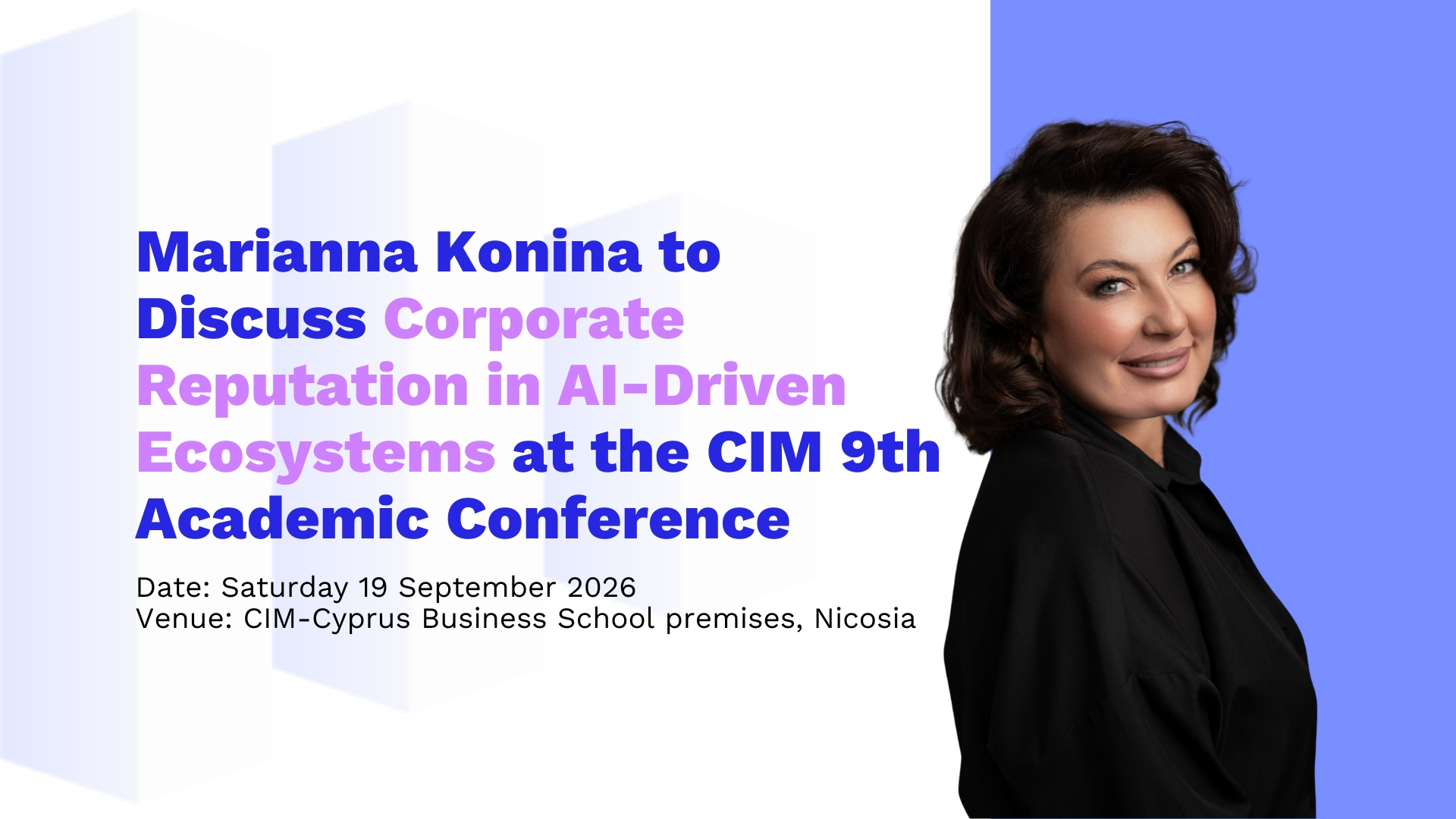
This growing gap will be addressed at the CIM 9th Academic Conference, where Marianna Konina, Founder and CEO of Reputation City, will speak on the topic:
“Generative Exposure Optimization (GEO): Managing Corporate Reputation in AI-Driven Information Ecosystems.”
Bringing Human and Artificial Intelligence Together
The conference, titled “Unveiling New Business Strategies: Bringing Human and Artificial Intelligence Together,” will take place on Saturday, 19 September 2026, at the CIM-Cyprus Business School premises in Nicosia.
The event will unite academics, researchers, business leaders, and industry professionals to discuss how artificial intelligence is transforming business intelligence, leadership, tourism, organizational development, digital authority, and corporate strategy.
Marianna Konina’s presentation will form part of the conference’s “Views from the Industry” program. Her session is scheduled for 13:45–14:00 and will introduce the business audience to a new reputational challenge: how companies appear, or fail to appear, in AI-generated answers.
Why GEO Is Becoming a Business Priority
For years, organizations have invested in search engine optimization to improve their visibility on Google. However, AI-driven platforms do more than rank links. They interpret information, combine data from different sources, and present users with a ready-made narrative about a company, brand, or executive.
This changes the very nature of corporate visibility.
A company may have a professional website and strong search positions, yet still be misrepresented, confused with another organization, or barely mentioned by AI systems. If reliable information is limited, fragmented, inconsistent, or difficult for machines to interpret, generative models may produce incomplete or inaccurate answers.
That is where Generative Exposure Optimization (GEO) becomes essential.
GEO focuses on how organizations are recognized, understood, and represented within AI-driven information ecosystems. It involves building a clear and verifiable digital presence, strengthening the consistency of corporate information, and monitoring how AI systems describe a company and its leadership.
It is an emerging area of reputation management.
When an AI-generated response shapes the first impression of a potential investor, partner, customer, journalist, or compliance professional, the accuracy of that response can have real business consequences. An incorrect answer may influence trust before a company has any opportunity to explain itself.
From Search Visibility to AI Visibility
Marianna Konina brings 20 years of experience in integrated communications across high-tech, media, enterprise, and B2B industries. As Founder and CEO of Reputation City, she works with leaders and organizations to manage their digital profiles and credibility across both search engines and AI systems.
Her participation in the CIM conference reflects Reputation City’s commitment to developing practical approaches to reputation management as technology changes the way information is discovered and evaluated.
The central message behind her upcoming presentation is clear: businesses can no longer focus only on what people see when they search for a company. They must also understand what AI systems learn, how they interpret available information, and what conclusions they communicate to users.
In the emerging information environment, silence can be interpreted as uncertainty, fragmented data can weaken credibility, and outdated information can continue shaping automated answers long after a company has changed.
Corporate reputation is no longer formed exclusively in public conversations. It is also being reconstructed inside algorithms.
The organizations that begin managing this new layer now will be better prepared to protect their credibility, maintain control over their corporate narrative, and build trust in an increasingly AI-driven business world.
To learn more about Marianna Konina’s contribution to discussions on reputation, leadership, and the future of business, read about her participation in the Cyprus Diaspora Forum.