
Reputation City’s New Expert Column in GBCY
A bank account can be closed in a day. The reputational consequences may follow a company for years.
When a financial institution terminates a corporate banking relationship, the immediate concern is usually operational: frozen payments, interrupted transactions, and the urgent need to find another bank. But the more dangerous question emerges shortly afterward: Why was the account closed?
Even when no allegation or enforcement action exists, an account closure can signal hidden risk. Other banks begin asking questions. Investors reconsider their exposure. Partners delay agreements. Journalists and AI systems may transform a compliance review into an implied accusation.
This reputational paradox is explored by Marianna Konina, Founder & CEO of Reputation City, in her latest expert column published in the August 2026 issue of GBCY Business Gazette.
Using the dispute between Capital One and the Trump Organization as a case study, the column examines how a confidential banking decision can evolve into litigation, political controversy, global media coverage, and a lasting problem with digital reputation.
Below is the article as published in GBCY Business Gazette.
THEY CLOSED THE BANK ACCOUNT. HOW IS IT CONNECTED TO THE REPUTATION CRISIS?
CAPITAL ONE, THE TRUMP ORGANIZATION, AND THE REPUTATIONAL PARADOX OF DEBANKING
By Marianna Konina, Founder & CEO, Reputation City
When a bank closes a corporate account, the payment problem is immediate. The reputational problem begins one question later: why?
I have seen companies prepare carefully for litigation, cyberattacks, regulatory inspections and negative media coverage, yet remain almost completely unprepared for one of the most disruptive events a business can face: the sudden loss of its banking relationship.
An account closure may appear to be a private decision between a financial institution and its client. In practice, it can quickly become something much larger. Other banks may begin asking questions. Investors may reassess risk. Partners may delay transactions. Journalists may interpret the closure as evidence of wrongdoing, even when no allegation or enforcement action exists.
The recent dispute between Capital One and the Trump Organization illustrates this problem at an unusually visible scale. But the underlying issue is not uniquely American, and it is not limited to politics.
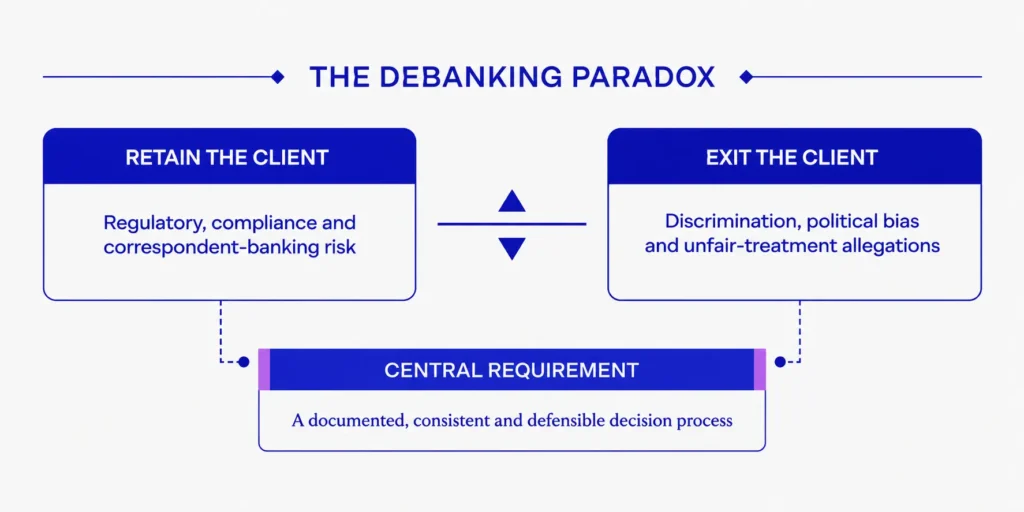
It is a conflict between two legitimate but competing reputational risks.
One decision, two reputational threats
On 31 July 2026, Capital One filed court documents explaining for the first time why it had decided to close more than 300 accounts associated with the Trump Organization in 2021.
According to ABC News, the bank said the decision followed an anti-money laundering review. Capital One did not accuse the Trump Organization of laundering money. It argued instead that its specialists had identified forms of transactional activity corresponding with risk patterns highlighted in federal banking guidance.
Capital One stated that the closures followed “months of analysis and a careful review” by its AML team in accordance with internal policies and regulatory guidance.
The Trump Organization and Eric Trump dispute that explanation. Their lawsuit alleges that the accounts were closed because of political bias following the events at the US Capitol on 6 January 2021. Capital One denies that political considerations determined its decision and is seeking dismissal of the case.
As Reuters reported, the bank described the political-pretext allegations as misguided and based on selected quotations presented without their full context.
The litigation remains a dispute between the parties. The important lesson for business leaders is not to decide who is right before a court does. It is to examine the position in which both sides now find themselves.
Capital One must demonstrate that it acted on the basis of a documented compliance assessment rather than political pressure. The Trump Organization must challenge the interpretation that the closures reflected legitimate financial-crime concerns.
Both parties are therefore defending something greater than a banking decision. They are defending the credibility of the process behind it.
“Debanking creates a reputational paradox. A bank may damage its credibility by keeping a relationship it cannot defend, but it may also damage its credibility by terminating that relationship in a way the public cannot understand.”
An AML indicator is not an accusation
This distinction is essential.
A transaction may trigger an AML indicator because of its size, structure, frequency, counterparties, geography or inconsistency with the customer’s expected economic profile. That does not by itself establish that a financial crime occurred.
The Central Bank of Cyprus AML Directive similarly requires credit institutions to examine complex or unusually large transactions, as well as unusual activity without an obvious economic or legitimate purpose. It also requires banks to consider factors such as new markets, customer profiles, countries of operation, and complex corporate ownership structures.
The purpose of this process is to identify and investigate risks. It is not a substitute for a judicial finding.
Yet public narratives rarely preserve that distinction. “Accounts closed following an AML review” can quickly become “accounts closed for money laundering.” A risk signal becomes an accusation; an internal decision becomes a public verdict.
This is where compliance risk becomes reputational risk.
For the affected company, correcting that implication can be extremely difficult. Headlines are condensed. Search results remove context. AI systems combine multiple reports into simplified summaries. Years later, a prospective bank or investor may encounter the closure without seeing the qualification that no allegation of money laundering was made.
“A bank can say that it has not accused a client of wrongdoing and still create a public association between that client and financial crime. Once that association enters search results, media coverage and AI-generated answers, the disclaimer may disappear while the implication remains.”
Why banks cannot simply explain everything
It would be easy to argue that banks should provide a complete explanation whenever they terminate a relationship. The reality is more complicated.
Financial institutions operate under confidentiality obligations that can prevent them from disclosing whether a Suspicious Activity Report exists or revealing information that would expose such a report. FinCEN’s guidance on SAR confidentiality explains that financial institutions and their representatives are prohibited from disclosing a SAR or information that would reveal its existence. One reason is to avoid alerting subjects and compromising potential investigations.
Banks therefore face a communications constraint: they may be expected to defend their decisions publicly while being unable to disclose the full basis for them.
But confidentiality does not eliminate the need for procedural credibility. A bank may be unable to discuss a specific alert or transaction. It can still demonstrate that it applies defined policies, conducts individual assessments, uses consistent escalation procedures, documents decisions, and provides reasonable notice where legally possible.
Transparency does not always mean revealing the evidence. Sometimes it means making the process’s integrity visible.
“When the facts must remain confidential, the process becomes the reputation. Stakeholders will judge whether the institution appears consistent, proportionate and politically neutral.”
De-risking is not the same as risk management
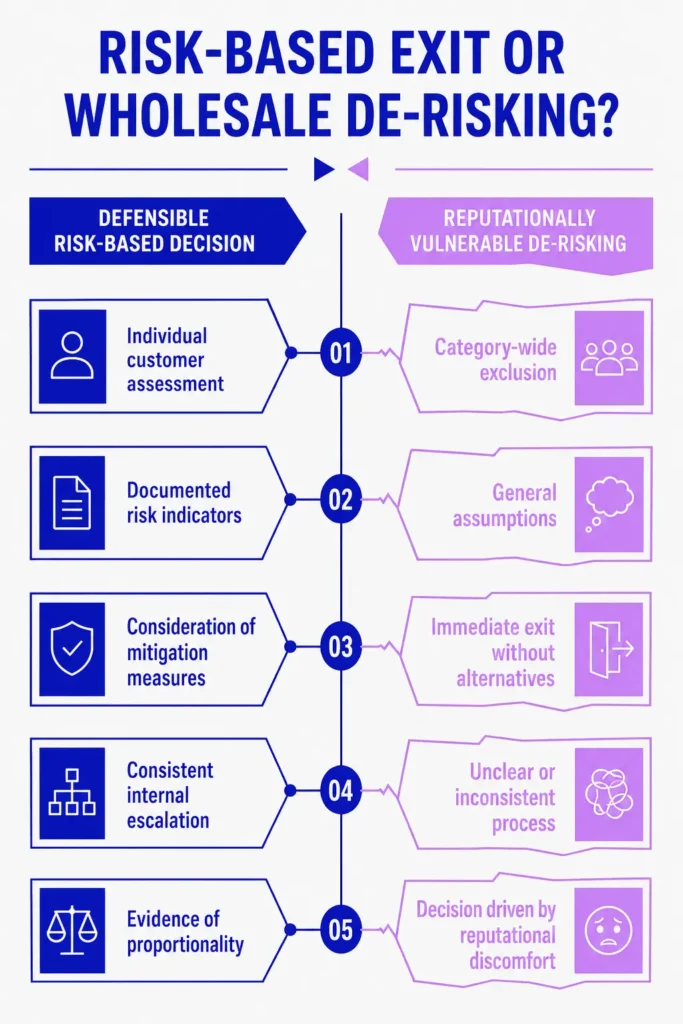
There is another important distinction between declining a particular relationship after an individual assessment and excluding entire categories of clients because they appear difficult or expensive to monitor.
The Financial Action Task Force’s 2025 guidance states that financial institutions may reasonably conclude, following an individual assessment, that they cannot adequately mitigate the risks of a particular customer. Refusing or terminating services in such circumstances is not inconsistent with a risk-based approach.
However, FATF also warns against wholesale de-risking: indiscriminately terminating or restricting relationships with customer categories rather than understanding and managing their specific risks.
The European Banking Authority’s guidelines address the same challenge. Financial-crime controls must be effective, but they should not result in unjustified denial of access to financial services.
This boundary matters because a bank’s risk appetite is not automatically evidence of discrimination. At the same time, labeling a sector, nationality, ownership structure or public profile as “high risk” cannot replace a proper assessment of the individual customer.
The closure follows the client
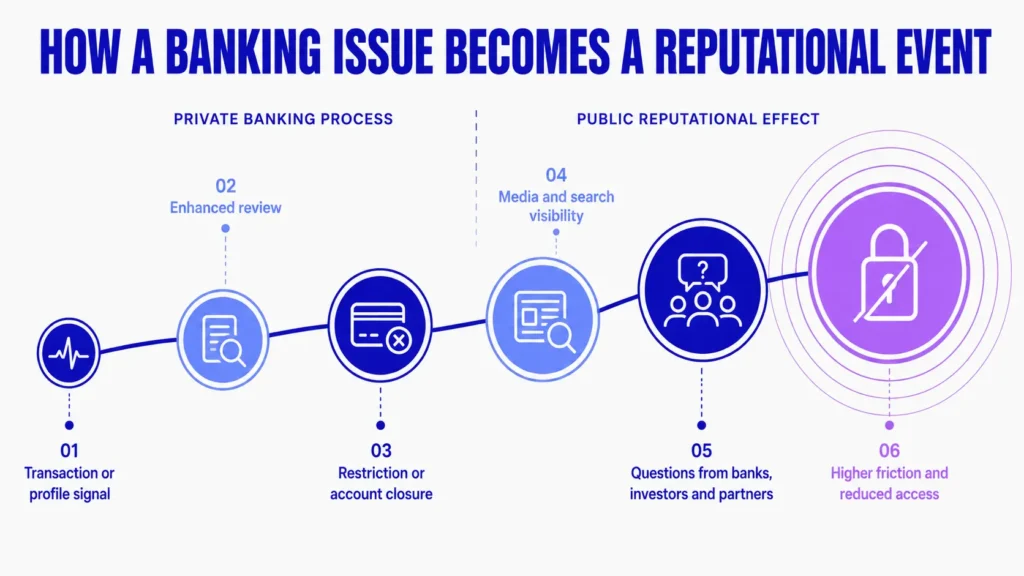
The most underestimated consequence of debanking is that the closure can become a portable reputation signal.
When a company approaches another financial institution, it may be asked whether a previous bank terminated the relationship. The new institution may conduct enhanced due diligence. It may search the company, its beneficial owners and directors. It may review media coverage, litigation, sanctions exposure, regulatory history and the commercial logic behind transactions.
The closure may also affect parties outside the banking sector.
An investor may interpret it as evidence of hidden compliance exposure. A payment provider may impose additional restrictions. A correspondent bank may request more information. A prospective partner may delay signing a contract while it conducts independent checks.
None of these reactions proves wrongdoing, but they create operational friction that can accumulate.
“A terminated account does not remain a closed chapter between the client and the bank. It can become metadata attached to the company’s reputation — a signal that every future institution feels obliged to investigate.”
The reputational problem becomes particularly serious when the public information environment contains no clear alternative explanation. If the only searchable material consists of allegations, account-closure notices, and litigation headlines, those sources begin to define the company’s risk profile.
The organization may know that its transactions were legitimate. The next bank can assess only the documentation and information it has access to.
Why this matters for Cyprus
For businesses operating from Cyprus, this case should not be dismissed as a dispute involving an American bank and an exceptionally political client.
Cyprus is home to international companies engaged in cross-border transactions, non-resident beneficial owners, holding structures, multiple payment providers, and operations spanning several regulatory environments. These characteristics can be entirely legitimate, but they also require a clear and consistently documented economic explanation.
The exposure is especially relevant for fintech, gaming, crypto, investment, payment, affiliate-marketing, and other digitally operated businesses. These sectors may experience rapid transaction growth, multiple counterparties, licensing complexity and frequent changes in geography or business models.
Complexity is not misconduct. Unexplained complexity is risk.
A bank may therefore need to understand:
- Who ultimately owns and controls the company?
- Where does its revenue originate?
- Why are funds moving between specific jurisdictions and entities?
- Does transaction activity correspond with the business model presented during onboarding?
- Are licenses, corporate records, and public descriptions accurate and current?
- Do media coverage and directors’ online profiles raise additional concerns?
- Can the company provide evidence quickly when its activity changes?
Companies need banking-reputation readiness
Many organizations respond to enhanced due diligence only after a bank sends a request. By that point, the company may be trying to reconstruct several years of decisions, transactions and ownership changes under severe time pressure.
A stronger approach is to maintain a permanent banking-reputation file containing:
- a current ownership and control structure;
- source-of-funds and source-of-wealth documentation;
- a clear explanation of the business model and revenue flows;
- licenses and regulatory permissions;
- reasons for material cross-border transactions;
- records explaining unusual increases or changes in activity;
- verified profiles of founders, directors and beneficial owners;
- a log of previous banking questions and the responses provided;
- monitoring of adverse media, litigation and misleading online claims;
- a response protocol for restrictions or termination notices.
The company should also test whether its public profile supports the story it gives the bank.
If the onboarding documents describe one activity while the website, business directories, executive profiles and media coverage suggest another, the inconsistency itself may become a risk signal. The same applies when ownership information is outdated or when a major change in operations has never been clearly communicated.
Reputation management cannot override an AML finding. It can ensure that accurate, verifiable, and current information is available when a financial institution assesses the company.
Banks need reputational defensibility too
Financial institutions also need to prepare for the possibility that a confidential compliance decision will become a public controversy.
The Capital One case demonstrates that an account closure made in 2021 can return years later as litigation, political debate, and global media coverage. The institution may eventually have to defend not only the outcome but also the consistency and neutrality of the process that produced it.
Before terminating a sensitive relationship, decision-makers should be able to answer:
- Was the customer assessed individually rather than primarily as part of a political, national, or industry category?
- Are the material risk indicators and internal escalation steps documented?
- Were reasonable mitigation measures considered before termination?
- Has the same policy been applied consistently in comparable cases?
- Can the institution explain its process without breaching AML or SAR confidentiality?
- Has the communications team prepared for allegations of discrimination, political bias or arbitrary treatment?
- Is the public statement precise enough to avoid turning a risk indicator into an implied accusation?
This is not merely a compliance exercise. It is preparation for future scrutiny.
The real question is whether the decision can survive daylight
The Capital One–Trump Organization dispute will be discussed politically because of the identities involved. But its significance for business is broader.
Banks are expected to detect and manage financial-crime risk. They are also expected to provide fair access, avoid discrimination and make proportionate decisions. Clients, meanwhile, must be able to explain their ownership, operations and transactional behavior before uncertainty becomes suspicion.
There may be circumstances in which terminating a relationship is necessary. There may also be legitimate limits on what a bank can disclose. But neither side can afford to treat the reputational consequences as an afterthought.
“In modern banking, the most consequential risk decision is not simply whether to keep or exit a client. It is whether the evidence, process and communication behind that decision will remain credible when regulators, courts, journalists and the public examine it years later.”
Debanking is no longer only the loss of an account.
For the bank, it is a test of institutional fairness. For the client, it can become a lasting signal of perceived risk. And for both, reputation will be shaped by the same question:
Can the decision be explained — and can that explanation be trusted?
Marianna Konina is Founder & CEO of Reputation City, a corporate reputational security company based in Cyprus, working with founders, executives, and growing businesses on building and protecting their digital trust profiles.
To explore another Reputation City expert column published in GBCY Business Gazette, read “Why Reputation Has Become the Fourth Pillar of Corporate Protection” and discover why reputational security now belongs alongside legal, financial, and cyber protection.
Have a questions? Let's get in touch
→ Contact us: hi@reputation.city