Reputation City’s New Expert Column in GBCY
You know what your company does. But could someone outside the business explain who owns it, how it earns money, and why payments move through its accounts?
In her latest expert column, Marianna Konina, Founder & CEO of Reputation City, examines how companies can prepare a clear, consistent, and verifiable profile before their next KYC review.
Our November Column in GBCY Business Gazette
We are delighted to share that Marianna Konina’s new expert column, “Can Your Bank Understand Your Business?”, has been published in the November 2026 issue of GBCY Business Gazette.
We are grateful to the editorial team for the opportunity to continue contributing to the conversation about corporate reputation, transparency, and business trust.
This month’s column explores the connection between reputation management and KYC preparation: whether a company’s documents, public information, and business explanations help an independent reviewer understand its activities. Drawing on the SEB enforcement case, Marianna outlines practical steps to identify information gaps, explain ownership and payment flows, and address inconsistencies before a review becomes urgent.
Below is the article as published in GBCY Business Gazette.
Can Your Bank Understand Your Business?
By Marianna Konina, Founder & CEO, Reputation City
What SEB’s $33 million penalty reveals about customer due diligence – and how companies can prepare a clear, consistent, and verifiable profile before their next KYC review.
I am currently undertaking CySEC AML training alongside my work in reputation security. This is strengthening my understanding of how KYC works in practice, particularly how information about an applicant’s reputation is researched, assessed and considered as part of a wider risk review.
You know your business is legitimate. But can someone outside your company understand how it works – and verify what you tell them?
That question sits behind many of the documents, ownership declarations, and explanations requested during Know Your Customer (KYC) checks. For entrepreneurs, these requests can feel repetitive. For a bank, they help establish whose money it is handling, why it is moving, and whether the activity makes sense.
A recent enforcement action shows what happens when that understanding is incomplete.
On 15 October 2026, the New York State Department of Financial Services announced that Swedish bank Skandinaviska Enskilda Banken AB (SEB) and its New York branch had agreed to pay a $33 million penalty over anti-money laundering and transaction monitoring failures. Although the announcement is recent, the findings concern historical conduct, including deficiencies in its Baltic subsidiaries between 2015 and 2019.
The lesson for business owners lies in the information gaps behind the headline.
The information a bank could not see
The regulator’s consent order, particularly paragraphs 12–16, describes missing information about customers’ main sources of funds and estimated business volumes, incomplete or incorrect beneficial ownership information, and files that failed to explain customers’ services or the countries where their main business partners were based.
It also identifies instances where customers self-reported information without independent verification.
These findings raise concerns about the bank’s controls. They do not establish that SEB was penalized because its customers had weak websites or incomplete LinkedIn profiles.
For companies preparing for scrutiny, however, they raise a practical question: how much of your business would a reviewer have to reconstruct from missing, outdated, or contradictory information?
“A business can be legitimate and still be difficult to understand. Preparing for KYC means reducing the distance between what the company does, what its documents show, and what an independent reviewer can verify.”
Start with who stands behind the company
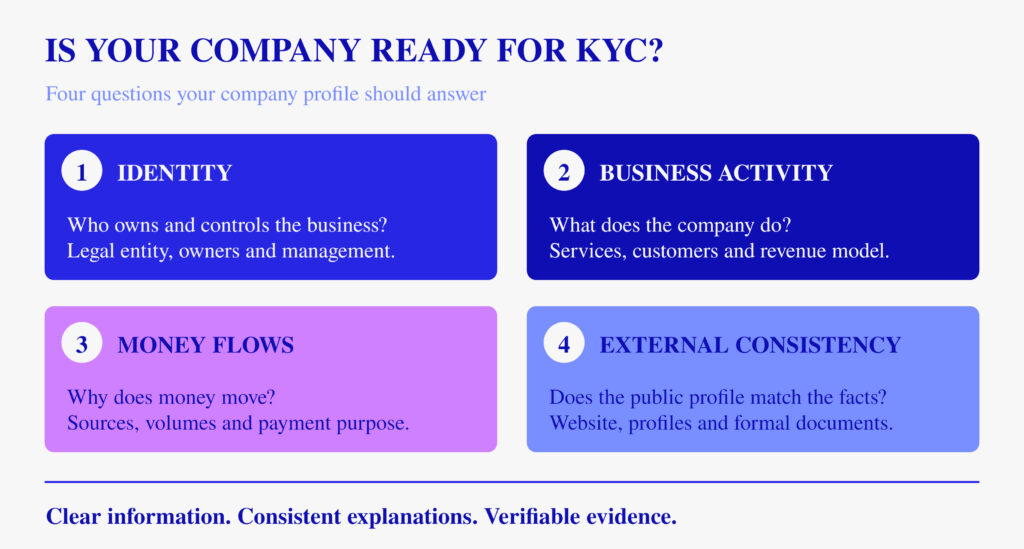
A useful starting point is a current company profile that connects the legal entity, trading name, group structure, owners, and management.
If your brand operates under a different legal name, explain the relationship. If several companies share a website, make clear which entity provides which service and signs the contracts.
Prepare an ownership chart that traces the structure to the ultimate beneficial owners, supported by the documents your bank requests.
Different addresses can also require context. A registered office, operating office, and correspondence address may all be valid, but their purposes should be clear.
The aim is to make the structure understandable without requiring the reviewer to guess how the pieces fit together.
Explain the business beyond the marketing language
“International consulting” may work as a broad description on a company registration form. It explains very little about the account's activity.
A more useful explanation identifies the services delivered, the types of customers buying them, the markets served, and how the company earns revenue.
Consider the difference between “we provide digital solutions” and “we develop subscription software for hospitality businesses and receive monthly license payments from customers in Cyprus and Greece.”
The second description gives a reviewer something concrete to assess against contracts, invoices, and expected payments.
Prepare that explanation before the questionnaire arrives. It should be accurate enough for your finance team and clear enough for someone unfamiliar with your industry.
Make the movement of money understandable
In practice, preparing for a review means being able to answer three connected questions:
how the applicant earned the existing funds, how the applicant earns money today, and how the applicant plans to generate future income.
For a business owner, this requires a clear account of the companies and activities behind those earnings.
Part of that explanation should also be visible in the public profile: how the relevant businesses fit into the group, what each does, and how the applicant is connected to them. Public descriptions should reflect the actual activities of those businesses and be consistent with the activity expected in the account.
Your finance team should prepare a realistic explanation of incoming and outgoing payments: their approximate volumes, currencies, frequency, principal countries, and economic purpose.
Supporting evidence may include customer contracts, invoices, supplier agreements, or documentation of shareholder funding, depending on the relationship and the bank’s requests.
Separate established activity from projections. A new company can explain its intended operations through available agreements, funding records, and a credible business plan.
Avoid adjusting the description simply to make the business appear less complicated. Complexity needs explanation.
“The strongest company profile is one that connects every important statement to evidence. A reviewer should be able to follow the explanation from ownership to operations to payments.”
Check whether the public profile tells the same story
This is where I see a practical role for reputation management: examining whether publicly available information supports an accurate understanding of the business.
Imagine a company applying for an account as a software provider while its website still advertises an earlier brokerage activity. Its founder’s biography names a former company, and a directory lists an outdated address.
This is an illustrative scenario, but it captures a useful preparation exercise. Each discrepancy may have an innocent explanation. Together, they create questions that the company could have addressed earlier.
Before focusing on the website, start by checking what screening databases may show about the company, its owners and relevant directors. Services such as LexisNexis WorldCompliance and LSEG World-Check can indicate the kind of information a reviewer may encounter, although the exact results depend on the bank’s tools, sources, and screening process. Arrange this through authorized access or a qualified adviser.
For personal information, both providers also offer routes for individuals to request access to records held about them and ask for inaccuracies to be corrected. This can help identify issues before an application becomes urgent.
If a search returns a sanctioned person with the same or a similar name, prepare a clear explanation and supporting identifiers that distinguish the applicant from that person. If you identify likely confusion, proactively provide the clarification through the bank’s secure channels rather than waiting for a question.
If information is inaccurate or outdated, request a correction or update from the original source and, where appropriate, the database provider. Keep copies of the request and any response so the reviewer can see what was challenged and what has already been corrected.
If screening databases flag adverse media, work with legal advisers to prepare a documented response before the bank asks. Where allegations or factual statements are disputed, prepare a legal rebuttal supported by evidence. Include the status of any proceedings and relevant corrections or outcomes, so that a clear response is ready for the reviewer’s first request.
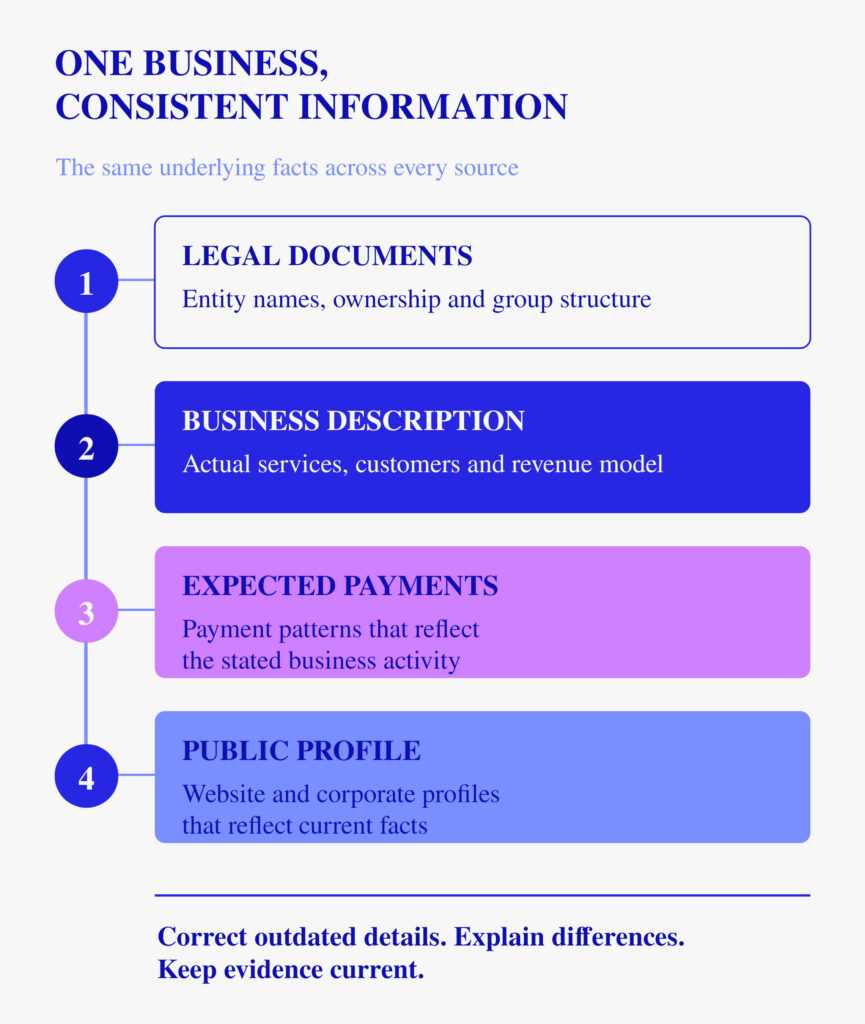
Review your website, corporate profiles, leadership biographies, relevant directories, and public coverage alongside your formal documents. Correct inaccuracies and explain material changes. Make the relationship between the brand and legal entity visible.
A company-controlled website remains a company-controlled source; repeating a claim across several profiles does not verify it independently. Provide sensitive ownership and financial documents through the bank’s appropriate channels.
Prepare before the review becomes urgent
Assign responsibility for keeping the company profile up to date. Gather input from management, finance, legal advisers, and communications so each team works from the same underlying facts.
Revisit the profile when ownership, services, markets, or payment patterns change. Keep supporting documents organized and record when you last checked key information.
This preparation cannot guarantee account approval. Banks apply their own requirements and risk appetite, and a clear profile does not remove substantive compliance concerns.
It does, however, put the company in a stronger position to answer questions accurately and provide the relevant evidence.
The SEB case concerns a bank’s historical failures. For entrepreneurs, its practical relevance is immediate: understanding a customer requires more than collecting a name and a registration certificate.
Before your next KYC review, ask someone unfamiliar with your company to read its profile. Can they explain who owns it, what it sells, why money moves through it, and which evidence supports those answers?
Your bank needs to understand your business. Preparing that explanation is a management responsibility worth taking seriously.
Marianna Konina is Founder & CEO of Reputation City, a corporate reputational security company based in Cyprus, working with founders, executives, and growing businesses on building and protecting their digital trust profiles. hi@reputation.city · +357 96 728 521 · reputation.city
For another perspective on how corporate trust is evolving, read Marianna Konina’s expert column in Cyprus Business Focus on how AI is reshaping business reputation.
Have a questions? Let's get in touch
→ Contact us: hi@reputation.city