
What if your company is already being evaluated by AI — but your leadership has no visibility into the answer?
This is no longer a hypothetical reputation risk. Buyers, investors, banks, partners, candidates, and journalists increasingly use generative AI to research organizations before making contact. By the time a company enters the conversation, an AI system may have already described it, compared it with competitors, or excluded it from a shortlist.
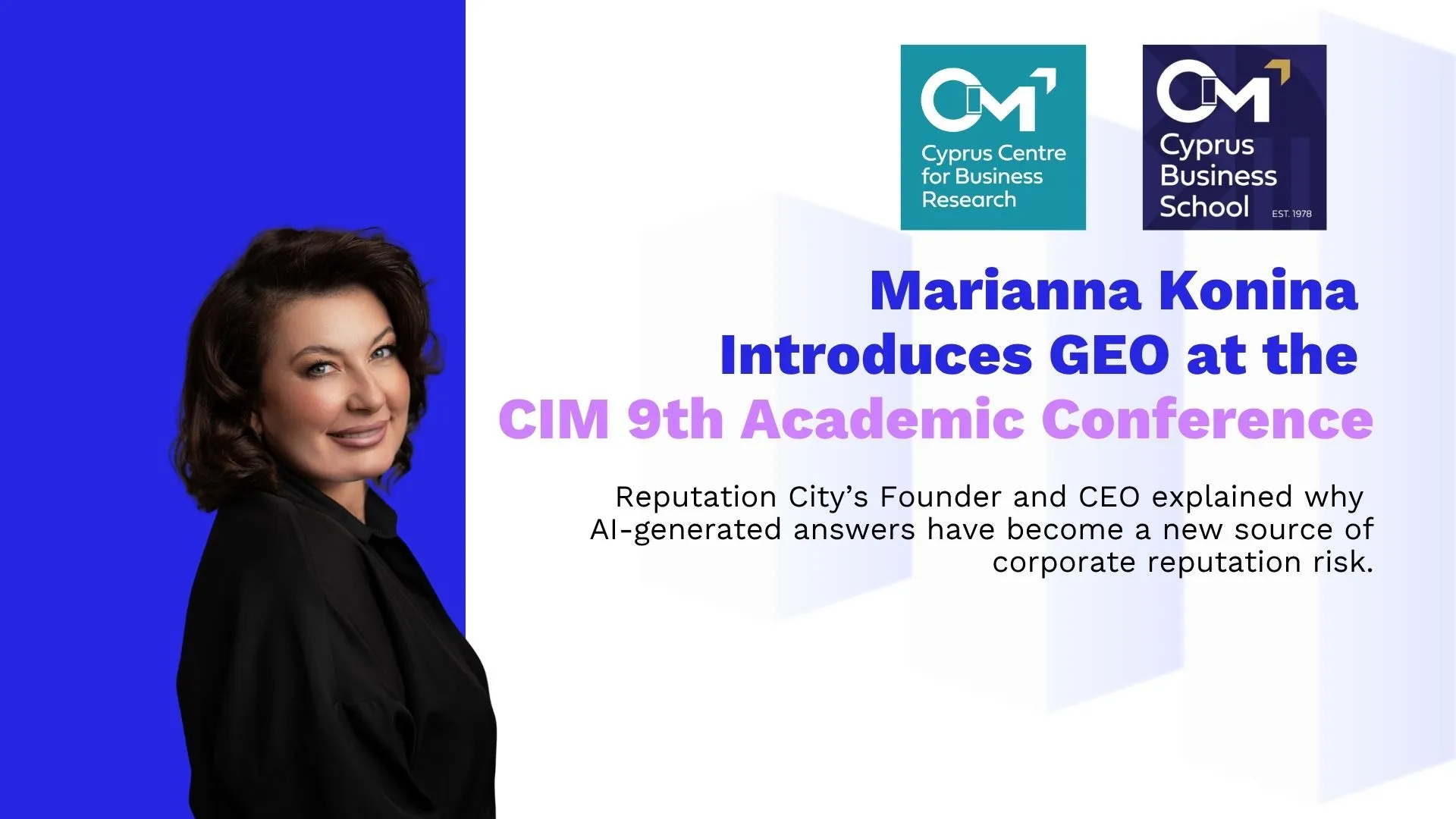
On 19 September 2026, Marianna Konina, Founder and CEO of Reputation City, addressed this shift at the CIM 9th Academic Conference, titled Unveiling New Business Strategies: Bringing Human and Artificial Intelligence Together.
Held at CIM-Cyprus Business School in Nicosia, the conference brought together academics and industry professionals to explore how human expertise and artificial intelligence are reshaping business strategy, leadership, and decision-making.
During the “Views from the Industry” session, Marianna presented “Generative Exposure Optimization (GEO): Managing Corporate Reputation in AI-Driven Information Ecosystems.”
From AI Visibility to Generative Exposure
The presentation challenged a common assumption: that appearing more frequently in AI-generated answers is automatically positive.
Traditional Generative Engine Optimization asks: How can a company get into the answer? It is primarily a visibility question, often measured through mentions and citations.
Generative Exposure Optimization asks a more important question: If the company is already in the answer, what is being said — and what could it cost the business?
This moves GEO beyond marketing. It becomes a leadership and reputation security issue measured not only by visibility, but also by accuracy, credibility, and potential exposure.
A company does not control whether AI systems describe it. It can, however, influence whether that description is based on structured, current, and independently confirmed information.
AI Does Not Rely on the Company Website Alone
Marianna explained that AI systems construct answers from three layers of information.
The first is what the company says about itself through its website, presentations, and corporate materials. The second is what official records confirm, including registries, licenses, regulators, and structured business data. The third is what independent parties say through media coverage, professional associations, partner websites, reviews, and online communities.
These layers do not carry equal weight. Corporate claims matter, but external confirmation gives them greater credibility.
An accessible and well-structured website helps AI systems read company information. However, it cannot independently validate every fact. If reliable information is missing, inconsistent, or outdated, the system may substitute data from another source — even when that source is inaccurate.
The Reputation Risk Hidden from Analytics
One of the presentation’s most important points was that AI influence often remains invisible in traditional reporting.
A potential client can ask an AI assistant to recommend five companies, receive a complete answer, and continue the decision-making process without clicking a single link. If a business is missing from that list, no lost inquiry appears in its CRM. If the answer contains outdated information, leadership may never know that a buyer saw it.
Marianna identified four principal risks: a company may be missing from relevant answers, described using outdated information, represented incorrectly, or flagged during AI-assisted compliance and due diligence checks.
The commercial consequences may include unseen shortlist exclusions, longer sales cycles, additional friction with banks and partners, and weaker perceptions among candidates or journalists.
Reputation Must Be Audited, Built and Monitored
The presentation concluded with a three-phase approach: audit, build, and monitor.
Companies should examine how multiple AI systems answer the questions their stakeholders are likely to ask. They must then strengthen the information environment around the business by making owned sources accessible, correcting inconsistencies and developing credible third-party confirmation. Monitoring must continue because AI answers and their underlying sources change over time.
For Reputation City, participating in the CIM conference was an important opportunity to bring reputation security into the broader discussion about AI and business strategy. We are proud that Marianna contributed an industry perspective to a program connecting academic research with the challenges companies already face.
Her message was clear:
AI is already writing your reputation. The strategic question is whether reliable sources are helping to write it.
To see how convincing an artificial corporate identity can become when its digital evidence looks stronger than that of a real business, read our article: What If a Fake Company Has a Better Digital Profile Than Yours?
Have a questions? Let's get in touch
→ Contact us: hi@reputation.city