
AI Does Not Replace Creativity. It Gives It Time to Work
What if the biggest creative threat is not artificial intelligence, but the amount of time people waste on work that requires no creativity at all?
For years, the debate around AI in marketing has focused on whether machines will eventually replace copywriters, designers, strategists, and content creators. But this question may be distracting businesses from a much more immediate reality: talented professionals are already losing a significant part of their working week to repetitive tasks.
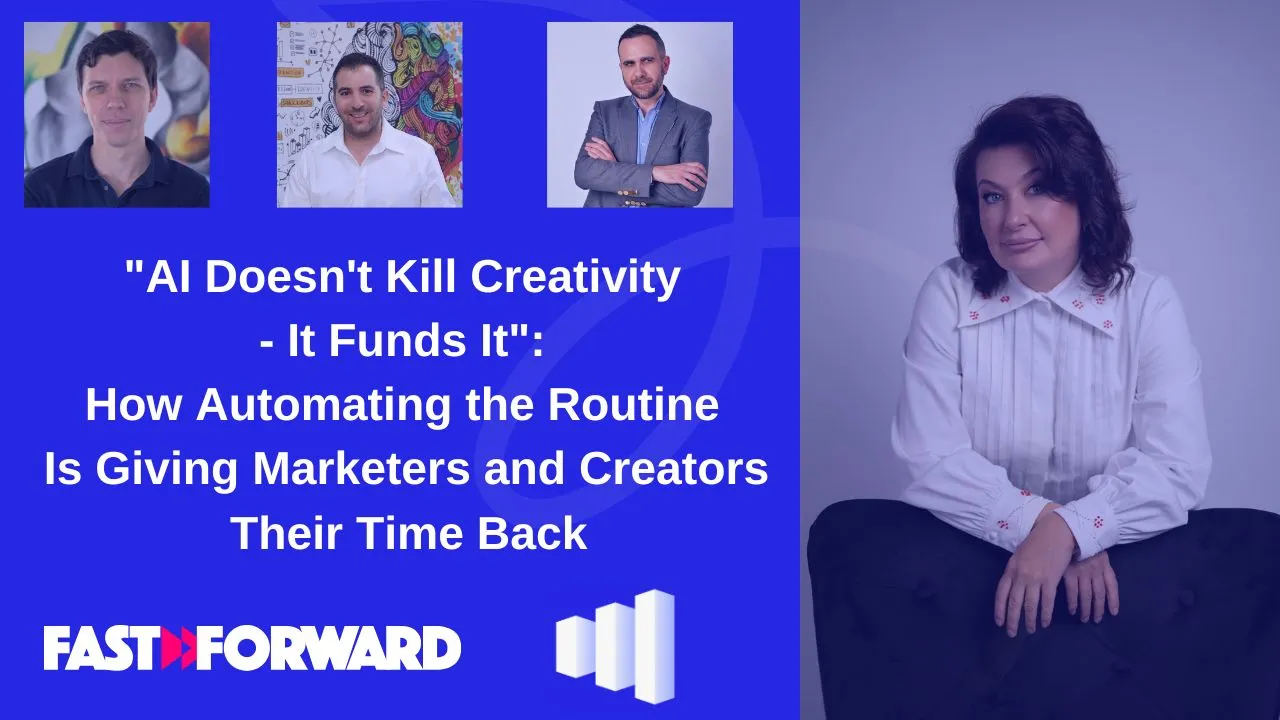
In her latest article for Fast Forward Magazine, Marianna Konina, Founder and CEO of Reputation City, explores a different perspective on AI. Instead of measuring the technology by how much content it can generate, she asks what becomes possible when automation gives professionals their time back.
The article is based on ideas presented at AI Expo Cyprus 2026, where experts from different areas of marketing arrived at a similar conclusion: AI delivers its greatest value when it handles routine work and allows people to focus on ideas, judgment, strategy, and communication.
The Hidden Cost of Routine Work
According to DoubleVerify’s 2025 Global Insights report, marketing professionals spend approximately 10 hours and 12 minutes every week on manual campaign optimization. This includes adjusting bids, reallocating budgets, monitoring viewability, and completing other repetitive tasks.
That represents around 26% of their working time.
For North American agencies, the report estimated that this routine workload could account for approximately $17,000 in lost value per employee each year. Although the figure cannot be applied equally to every country or company, the underlying problem exists across markets: highly skilled people regularly spend hours performing tasks that technology can already handle.
However, simply saving time is not enough.
If automation removes ten hours of routine work but the business has no plan for how to use those hours, the real return remains limited. The more important question is not how much time an AI tool saves, but what the team creates, improves, or discovers with the time it returns.
AI Tools Should Fund Better Work

During AI Expo Cyprus, AI expert Igor Akimov presented five tools that can pay for themselves in a short period. His approach focused not only on their features but also on how quickly they could become part of a team’s normal workflow.
This changes the way companies should evaluate AI investments.
A tool should not be considered valuable simply because it automates a task. Its value depends on whether it gives a specialist more time to develop a stronger campaign, improve a client brief, research an audience, test an original idea, or address a reputational risk before it becomes a crisis.
From this perspective, AI does not compete with human creativity. It funds it by removing the tasks that consume time without requiring meaningful human judgment.
Technology Cannot Decide What an Audience Needs

Manos Gryparis, CEO of PRWorld.gr and Head of Social Media at Cryptonews.com, approached the issue from the practical side of content production.
His workflow includes tools for improving titles and thumbnails, preparing hooks and publishing schedules, generating visual concepts, accelerating video production, and managing posts across several platforms.
Together, these tools can significantly reduce the time required to produce and distribute content. But the purpose is not to publish more material simply because the technology makes it possible.
The real objective is to create something useful: content that answers a question, solves a problem, offers an original insight, or provides the audience with information they cannot easily find elsewhere.
AI can help accelerate execution, but it cannot independently understand why a message matters to a particular audience. It also cannot take full responsibility for tone, context, sensitivity, or the reputational consequences of what is published.
Those decisions remain human.
A Collection of Tools Is Not a Strategy

Orestis Michael, Founder and CEO of MamaCRM, added another important layer to the discussion: companies often confuse the use of AI tools with having an AI strategy.
Automated reporting can show what happened more quickly. Scheduling platforms can publish content more efficiently. Generative tools can produce several variations of a text or visual within seconds.
But none of these systems can independently define what a brand should say next, which position it should take, or how a message supports its long-term identity.
Moving faster does not help if the company is moving in the wrong direction.
This is especially important from a reputation management perspective. Every piece of published content contributes to a business’s digital identity. Search engines, potential clients, banks, investors, partners, and AI platforms may all use that information when assessing the company.
Therefore, faster content creation must be supported by clear positioning, verified information, editorial control, and an understanding of reputational risk.
Why This Matters to Reputation City
At Reputation City, we work with companies whose digital presence may be examined during important business moments: opening bank accounts, attracting investment, entering new markets, undergoing compliance checks, or building relationships with international partners.
In these situations, content is not merely a marketing asset. It becomes part of the company’s digital due diligence.
AI can help teams monitor media, analyze search results, detect information gaps, accelerate research, and simplify repetitive production processes. It can also help businesses understand how they appear across search engines and generative platforms.
However, technology cannot replace the strategic decisions behind a credible digital identity.
A company still needs to decide which facts should be visible, which sources deserve trust, how its expertise should be communicated, and whether every public statement supports the reputation it wants to build.
This is why the topic of Marianna Konina’s Fast Forward article is particularly important to us. The conversation about AI should not be reduced to whether machines can produce more content than people. Businesses should ask whether automation allows their teams to produce better, more useful, and more responsible communication.
Cyprus Cannot Afford to Ignore the Gap
The question is especially relevant to the Cypriot market.
Eurostat figures cited in the original article showed that in 2025, AI was used by 9.27% of Cypriot enterprises with at least ten employees. The EU-27 average was 19.95%.
This gap is not only about technology adoption. It may also affect productivity, competitiveness, and the ability of local businesses to operate effectively in international markets.
Companies that continue to assign repetitive work to experienced professionals are paying a hidden cost. At the same time, implementing AI without a clear strategy can create new risks, including inconsistent communication, factual errors, generic content, and reputational damage.
The strongest approach lies between these extremes: automate what is repeatable while protecting the human judgment that gives communication its meaning.
The most valuable outcome of AI is not the number of tasks completed or hours recorded as “saved.” It is the quality of the work that replaces them.
Read the full article by Marianna Konina in Fast Forward Magazine: “AI Doesn’t Kill Creativity — It Funds It”: How Automating the Routine Is Giving Marketers and Creators Their Time Back.
To explore the other side of AI-generated creativity and the reputational risks it can create, read our article: Not Every Dream Deserves to Become Real: The Reputation Risks Behind AI-Generated Content.