
South Korea Is Investing $576 Billion in AI. Is Your Company’s Reputation Ready for the AI Economy?
What if the biggest AI race of the next decade isn’t about ChatGPT at all?
While many businesses are still debating whether to integrate AI into their daily operations, South Korea has already made a much bigger decision: it is building the infrastructure that will power the next generation of artificial intelligence.
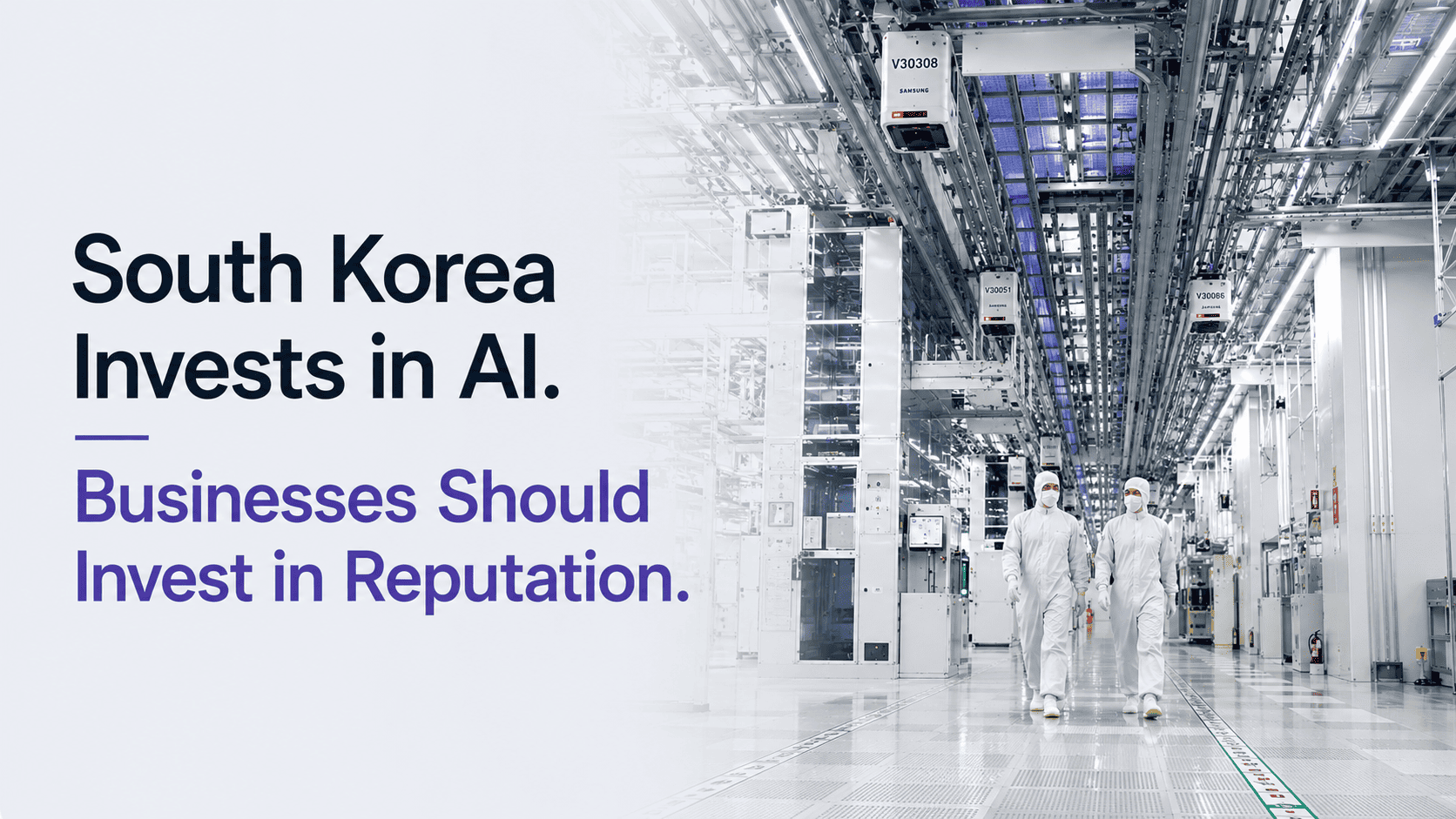
The country has announced one of the largest industrial investments of the 21st century – a $576 billion national AI initiative that will transform South Korea into a global hub for AI chips, high-bandwidth memory (HBM), data centers, and robotics. The project includes the construction of four new semiconductor fabs by Samsung Electronics and SK Hynix, backed by massive government support. According to Reuters, the initiative aims to position South Korea as one of the world’s leading AI infrastructure providers.
At first glance, this may seem like another story about technology and manufacturing. In reality, it signals something much bigger.
It confirms that AI is becoming national infrastructure – just like electricity, roads, or the internet once was. And when AI becomes infrastructure, your company’s digital reputation becomes part of that infrastructure.
AI Is Becoming the First Place Where Businesses Are Evaluated
For years, companies invested in SEO because Google was the primary gateway to information, but today, that gateway is changing.
Business owners, investors, journalists, partners, and even potential clients increasingly ask ChatGPT, Gemini, Claude, or Perplexity questions before opening a website or contacting a company.
Instead of browsing through ten search results, people now receive a single AI-generated answer. That answer is built from the information AI systems can find, verify, and trust.
This changes reputation management completely. Companies are competing to become the version of the truth that artificial intelligence repeats.
Infrastructure Creates Power. Information Creates Trust.
South Korea’s strategy focuses on producing AI hardware. But hardware alone does not create intelligence.
AI models rely on data. Every article, interview, company profile, review, press mention, industry publication, government registry, and LinkedIn profile becomes part of the knowledge ecosystem AI uses to generate answers.
If that ecosystem contains outdated information, inconsistent messaging, negative media coverage, or simply very little information about your business, AI cannot confidently represent your company.
Instead, it may:
- prioritize old or misleading information;
- amplify negative publications;
- ignore your achievements completely;
- generate incomplete or inaccurate descriptions of your business.
The better the AI infrastructure becomes, the more valuable trusted information becomes.
Reputation Is Becoming a Strategic Asset
Many executives still think online reputation is mostly about public relations or crisis communications.
That perspective is quickly becoming outdated. Today, reputation directly affects business opportunities.
- Banks perform digital due diligence before opening accounts.
- Investors research founders long before scheduling meetings.
- Partners verify companies before signing contracts.
- Recruiters evaluate leadership online.
Now, AI platforms are becoming another layer of that verification process.
When someone asks AI whether your company is trustworthy, innovative, experienced, or reliable, the answer depends on your digital footprint-not your marketing materials.
This is why at Reputation City we often say:
Reputation is the new KYC.
As AI becomes part of business decision-making, digital identity becomes part of compliance, trust, and access.
The Companies That Prepare Today Will Benefit Tomorrow
South Korea’s investment demonstrates how seriously governments now view artificial intelligence.
Businesses should treat this as an early warning.
The AI economy will reward organizations that build structured, credible, and verifiable digital identities. Waiting until AI platforms misrepresent your company is already too late.
Instead, organizations should proactively:
- publish expert content that AI can reference;
- ensure company information remains consistent across platforms;
- build authoritative digital profiles across trusted sources;
- monitor how AI systems describe their brand;
- strengthen their presence through trusted media coverage and strategic reputation management.
This is precisely where Generative Exposure Optimization (GEO) becomes essential.
Unlike traditional SEO, GEO focuses on ensuring AI models understand, recognize, and accurately describe your company by strengthening the trusted information ecosystem they rely on.
As AI becomes the world’s default information layer, visibility alone is no longer enough.
The goal is credibility.
The AI Race Is Also a Reputation Race
Countries are investing hundreds of billions into AI infrastructure because they understand where the future economy is heading.
Businesses should draw the same conclusion.
The next competitive advantage will belong to companies that artificial intelligence trusts. That trust is earned long before someone asks ChatGPT a question.
It is built through consistent digital presence, authoritative content, credible media coverage, and a reputation ecosystem designed for both people and AI.
Further reading: Deepfakes are no longer just a celebrity issue – they’re becoming a serious business reputation risk. Learn why companies should prepare now in our latest article: “Are Deepfakes Only a Celebrity Problem? No, They’re Becoming a Business Crisis.“