
When a Founder’s Reputation Becomes a Corporate Security Issue
A company can survive a weak quarter. It can renegotiate debt, replace a supplier, or recover from a failed product launch. But what happens when the risk investors cannot overlook is the founder?
In founder-led businesses, the boundary between personal and corporate reputation has almost disappeared. Banks, investors, potential partners, and AI platforms do not evaluate the company in isolation. They examine the people behind it—their previous ventures, ownership connections, public statements, disputes, and the consistency of their digital profiles.
This means a business opportunity can disappear before the company even knows it was being considered.
At Reputation City, we believe this shift requires businesses to think beyond conventional reputation management. A founder’s digital presence is no longer merely a matter of visibility or personal branding. It is part of the company’s risk profile—and, increasingly, part of its corporate security.
That is the central argument explored by Marianna Konina, Founder and CEO of Reputation City, in her expert column for the GBCY Business Gazette. The article examines how founder reputation can either undermine confidence, as the WeWork case demonstrates, or become measurable business capital, as illustrated by Female Invest.
Below is the article as published in the GBCY Business Gazette.
When a Founder’s Reputation Becomes a Corporate Security Issue
By Marianna Konina, Founder & CEO, Reputation City
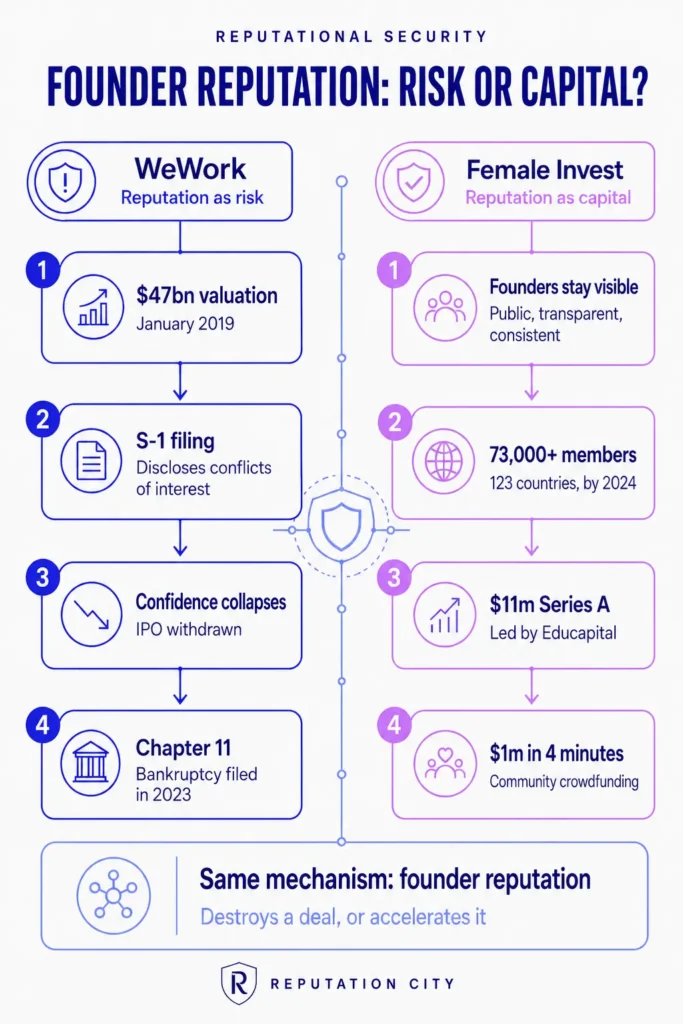
In January 2019, WeWork was valued at approximately $47 billion. Nine months later, its planned IPO had collapsed, founder Adam Neumann had stepped down as CEO, and the company needed a multibillion-dollar rescue package from SoftBank. The change was not triggered by one negative article. It accelerated when WeWork submitted its Form S-1 to the US Securities and Exchange Commission. The filing gave investors a detailed view of the company’s finances, governance and relationship with its founder.
It disclosed Neumann’s extensive voting control, related-party transactions, arrangements involving businesses connected to him and potential conflicts of interest. These details intensified existing concerns about WeWork’s losses and business model. The founder who had helped create the company’s investment premium became part of the risk investors were being asked to accept.
Neumann was not criminally charged over these governance concerns, and the founder’s reputation was not the only reason for WeWork’s decline. The company also faced substantial losses and long-term lease obligations. But once investors lost confidence in the person controlling the business, the entire growth story became harder to believe. The IPO was withdrawn, the valuation collapsed, and WeWork entered Chapter 11 bankruptcy in 2023.
Following restructuring, WeWork emerged from bankruptcy in June 2024 after eliminating more than $4 billion in debt. The case illustrates a point that matters far beyond large public companies: when a founder is closely identified with a business, doubts about that person can change how every other weakness is interpreted.
Due Diligence Starts With the Founder
There is no reliable global statistic showing how many companies are rejected specifically because of a founder’s online reputation. Investment decisions are confidential, and failed transactions are rarely attributed to one factor. A deal may be stopped because of governance, compliance, integrity or ownership concerns, even when public information about a founder first drew attention to the risk.
Dealsuite’s 2026 European M&A Monitor, based on input from 848 mid-market advisory firms, shows that company-specific risk has a measurable impact on SME valuations. The average EBITDA multiple ranged from 3.9 for companies with a normalized EBITDA of €200,000 to 7.2 for businesses with an EBITDA of €10 million. Dealsuite explains that smaller companies carry a higher risk premium partly because they are more dependent on individual customers, suppliers and key expertise.
In founder-led SMEs, this dependence often extends to the founder, in whom expertise, commercial relationships and credibility may be concentrated. The founder’s risk profile can therefore influence how investors assess the resilience and value of the entire business.
The Decision-Making Process May Begin Before the Company Is Ever Contacted
This assessment frequently begins before a company is contacted. An investor or its representatives can search the founder and beneficial owners, review previous directorships, compare biographies with corporate records, and examine media coverage. Banks and major commercial partners follow similar procedures during onboarding.
A company may therefore lose an opportunity without knowing that the founder has already been assessed. The investor may never explain that an unresolved dispute, an inconsistent biography or an unclear ownership connection caused concern. The conversation may simply stop.
The external review commonly follows four stages:
- External review begins. The founder, beneficial owners and company may be screened before they are contacted.
- Open-source research. Search engines, corporate and regulatory records, previous directorships, ownership data, professional profiles, media coverage, business directories, reviews and AI-generated answers are examined.
- Data verification. Biographies are compared with corporate records, previous business links are checked, and important claims are tested against independent sources. Outdated information, missing context, identity confusion and contradictions are identified.
- Risk assessment. The connected profile is assessed for governance risk, integrity concerns, unclear ownership, conflicts of interest and credibility gaps. Individual facts are interpreted as a pattern, not in isolation.
The decision-maker then determines whether the risk profile is clear and acceptable. There are three possible outcomes: proceed, request clarification, or stop the process because the perceived reputational risk outweighs the potential value.
The company may never know that reputational screening influenced the decision. The conversation may simply stop.
Founder Reputation Shapes Trust
Most businesses protect their stability through three established systems. Legal security covers contracts, regulation and legal rights. Financial security protects cash flow, assets and shareholder value. Cybersecurity protects infrastructure, systems and data.
Founder-led businesses also need a fourth pillar: reputational security. It protects the information that shapes trust in both the company and the person behind it. It begins with a practical question: what will a bank, investor or partner find when they search the founder, and can that information be verified and properly understood?
This is not another name for personal branding. It is not about manufacturing a flawless image or hiding legitimate criticism. A polished LinkedIn profile cannot compensate for an undisclosed conflict of interest, and media coverage cannot repair weak governance.
Reputational security means identifying inaccurate, outdated or fragmented information before it distorts a legitimate assessment of the business.
A company may be legally compliant and financially stable but still appear risky if searches for its founder are dominated by unresolved allegations. It may have strong cybersecurity controls but lose a partnership because the founder’s links to previous companies are unclear. It may offer a credible product but struggle to raise capital because the founder’s expertise cannot be independently verified.
For SMEs, the exposure is concentrated. The founder may also be the principal shareholder, CEO, spokesperson and source of key commercial relationships. There is little distance between the individual’s reputation and the company’s perceived reliability.
Female Invest: When Founder Credibility Becomes Capital
The same connection can work in a company’s favor. Female Invest is a Danish financial education business founded in Copenhagen in 2019 by Emma Due Bitz, Camilla Falkenberg and Anna-Sophie Hartvigsen. Its platform helps women develop their knowledge of personal finance and investing.
The founders did not remain anonymous behind the corporate brand. They became visible representatives of its mission through financial education, public speaking, community engagement and consistent communication about the gender gap in investing.
By 2024, Female Invest reported more than 73,000 paying members across 123 countries and a community of over 500,000 followers. That year, the company raised $11 million in Series A funding, led by Educapital and Rubio Impact Ventures.
Part of the round was offered to the company’s community. More than 13,000 people registered, and the crowdfunding campaign raised $1 million in four minutes. According to Female Invest’s official Series A announcement, 94% of participating investors were women.
The founders’ visibility did not replace the need for a viable business. Female Invest already had paying customers, international growth and a working subscription model. Their credibility made that commercial case more persuasive. Customers had followed the founders, used the product and observed whether their actions matched the company’s stated mission. Trust built over time became measurable financial support.
For an SME, this is more useful than the story of a global celebrity founder. A founder does not need international fame to influence an investment decision. Credibility grows through expertise, transparency, consistent delivery and direct relationships with stakeholders.
The Founder’s Digital Profile Is Now Part of the Company Profile
Search engines and LLMs no longer keep personal and corporate reputation separate. A search for a company quickly leads to its founder, previous ventures, interviews, disputes and professional profiles. A search for the founder leads back to the company.
AI platforms make the connection even tighter by combining corporate websites, media reports, directories, regulatory records, reviews and leadership profiles into one answer.
The result may include an outdated directorship, an allegation without its later resolution or information about another person with a similar name. Because an AI-generated answer is coherent and confident, incomplete information can appear more authoritative than it is.
As a business grows, this scrutiny extends to the CEO, beneficial owners and directors. Their profiles matter because they can create additional risk around the founder and the company. But for founder-led SMEs, the founder remains the central reputational reference point: the person stakeholders use to judge whether the company’s promises, governance and strategy are credible.
What Should Founders Check Before an External Review?
Before fundraising, bank onboarding, market entry or negotiations with a strategic partner, founders should review their own digital profile as an external decision-maker would.
The review should cover search results in relevant countries and languages, answers produced by major AI platforms, previous directorships, ownership records, professional biographies and media coverage. Important claims should be supported by credible independent sources.
Incorrect information should be corrected at its source where possible. Legitimate historical problems should be explained with evidence and proper context. Gaps should be addressed through clear corporate materials, credible media coverage and substantive expert contributions.
The objective is not only to create a perfect founder profile. Experienced investors do not expect spotless histories. They expect transparency, consistency and a risk profile they can understand.
WeWork shows how concerns surrounding a founder can become inseparable from the perceived risk of a company. Female Invest shows the opposite: when founder credibility, business results and public communication support one another, reputation can become a form of capital.
Start by reviewing what an investor, bank or partner would find if they searched you today. Check the search results, the AI-generated summaries, previous directorships and media coverage across the languages and countries relevant to your business.
Reputation City offers a free Reputation Profile Overview—a first look at how your digital profile reads to an outside decision-maker. The first ten companies to reach out will receive it at no cost. Contact us at hi@reputation.city.
This is another article we prepared for the GBCY Business Gazette, exploring why reputation is no longer simply a matter of public perception but a core element of corporate security. Read it here: Why Reputation Has Become the Fourth Pillar of Corporate Protection.