
Reputation City’s New Expert Column in GBCY
Your company can rank first on Google and still lose a potential client because of a single AI-generated answer.
Who defines your business when a customer, investor, or partner asks ChatGPT about it? Your official website may tell one story, while outdated directories, media coverage, and professional profiles tell another. The answer that brings them together can shape a decision before your company has an opportunity to speak.
This is the focus of “ChatGPT Is Now a Search Engine. Is Your Reputation Ready?”, the new expert column by Marianna Konina, Founder and CEO of Reputation City, published in GBCY Business Gazette.
The column explores what ChatGPT’s designation as a Very Large Online Search Engine means for corporate reputation, how generative search changes the way businesses are evaluated, and why inaccurate descriptions or exclusion from AI answers can have commercial consequences. It also outlines practical steps companies can take to strengthen the information those answers depend on.
Reputation City thanks GBCY Business Gazette for the opportunity to share Marianna’s expertise and bring this important discussion to its business readership. We appreciate the platform to help companies understand how digital trust is built, interpreted, and protected in the AI era.
Below is the article as published in GBCY Business Gazette.
ChatGPT Is Now a Search Engine. Is Your Reputation Ready?
The EU’s new classification confirms that AI-generated answers have become part of the infrastructure shaping corporate trust
By Marianna Konina, Founder & CEO, Reputation City
A company can rank first on Google and still lose control of the answer that matters.
For years, businesses treated ChatGPT as a productivity tool rather than a system customers, investors, and journalists used to discover information.
That distinction has become difficult to defend.
On 31 August 2026, the European Commission formally designated ChatGPT as a Very Large Online Search Engine (VLOSE) under the Digital Services Act. The Commission explained that ChatGPT qualifies as a hybrid service that can answer users’ queries, including by searching the web.
The classification applies because the service exceeded the DSA threshold of 45 million average monthly users in the European Union. The Commission’s official register of designated services currently lists ChatGPT with 159.1 million average monthly active users in the EU.
This regulatory decision concerns OpenAI’s responsibilities. It does not impose new DSA obligations directly on every company mentioned by ChatGPT. Its wider significance for business, however, is difficult to ignore.
The law has formally recognized what users had already decided: ChatGPT is no longer only a tool that generates text. It is an information intermediary through which people search for and evaluate organizations.
“The EU did not make ChatGPT influential by classifying it as a search engine. It classified ChatGPT because that influence had already become too significant to regulate as an ordinary digital service.”
From a List of Links to a Finished Answer
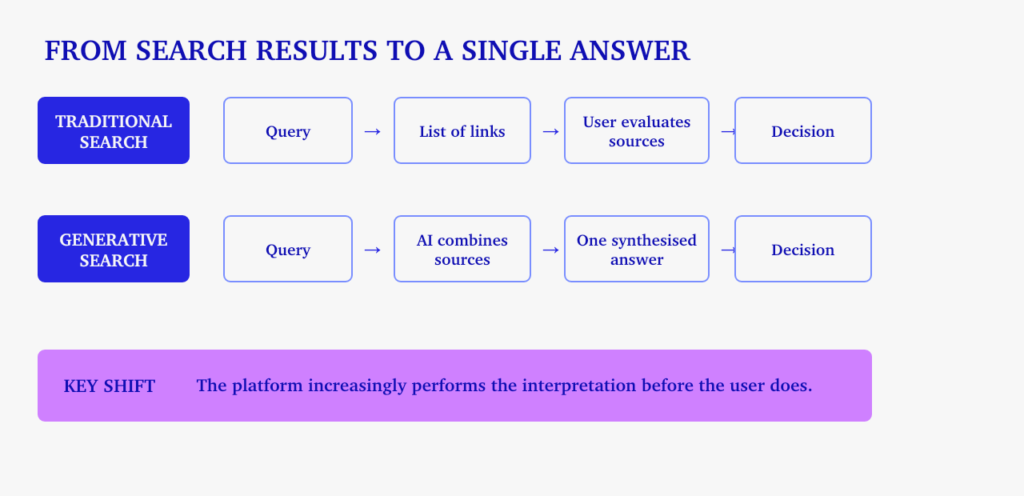
Traditional search engines normally present multiple results. Users choose which links to open, compare the sources, and form their own conclusions.
Generative search changes that journey.
A user can ask ChatGPT whether a company is reliable, who owns it, whether it has faced controversy, or how it compares with competitors. Instead of presenting only a ranked list of links, the system can produce one coherent answer based on corporate websites, media reports, professional profiles, business directories, regulatory records and reviews.
The user may never visit the company’s website or inspect the original sources. They may not notice that one fact is current while another is several years old.
The summary itself becomes the first impression.
For a company, visibility now depends on more than appearing in search results. It also depends on whether AI systems understand the organization correctly, connect it with the right people and entities, and distinguish established facts from allegations.
What the VLOSE Designation Means
According to the European Commission’s official announcement, OpenAI has four months after notification — until January 2027 — to comply with the additional obligations that apply to very large online search engines.
These include assessing and mitigating systemic risks connected with:
- illegal content;
- negative effects on minors;
- users’ physical and mental well-being;
- fundamental rights;
- electoral processes;
- public security.
The designation also gives the Commission investigative powers to examine the relevant functions and systems.
However, the decision does not mean that every ChatGPT answer is verified or legally authoritative. Nor does it guarantee that information about a company will be complete, current, or presented in the correct context.
A platform can face stronger accountability requirements and still generate an answer based on fragmented or conflicting sources.
“Regulation can increase platform accountability, but it cannot repair a company’s digital profile on the company’s behalf. If the underlying information ecosystem is inconsistent, the AI answer may reproduce that inconsistency at scale.”
AI Does Not See a Brand the Way Its Management Does
A leadership team understands its company through internal facts: its strategy, products, licenses, ownership, and business results.
An AI system encounters a different version.
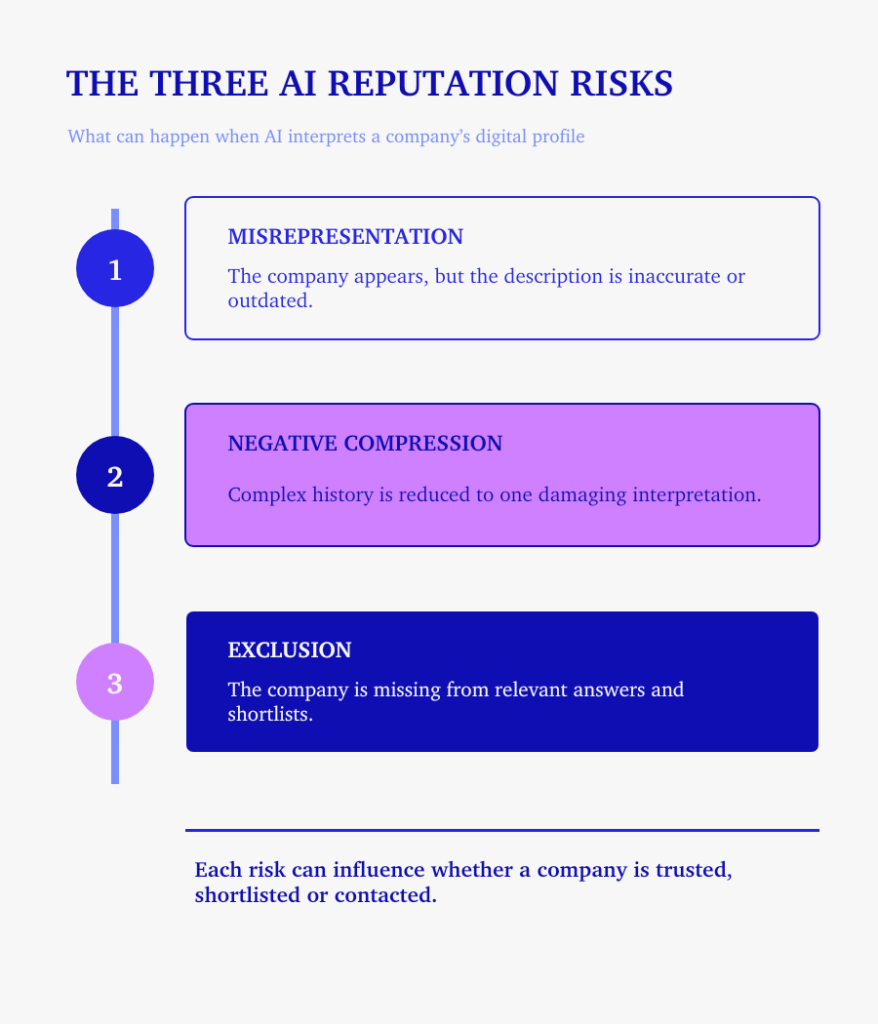
It may find an official website describing one business model, an outdated directory showing another, and a former executive still presented as a current director. It may discover several corporate entities without a clear explanation of how they are connected. It may find a resolved dispute but not the later resolution.
From inside the company, these may seem like minor digital inconsistencies. From outside, they can create uncertainty about ownership, credibility, or risk.
Generative systems also combine information. A historical problem involving one subsidiary can influence an answer about the wider group. Information about a founder can shape the company’s description. Several articles may appear to provide independent confirmation even when they repeat the same original claim.
The output may sound clear even when the source environment is not.
Being Absent from the Answer Is Also a Risk
Companies naturally focus on inaccurate or negative AI content. But exclusion can be equally consequential.
A prospective client may ask:
- Which Cyprus companies have experience with international businesses?
- Which fintech providers demonstrate strong compliance standards?
- Which property developers have a credible record with foreign buyers?
- Who are the recognized experts in a particular sector?
If a company is not included, it may never enter the decision-making process.
This differs from ranking on the second page of Google. A conventional search lets the user keep browsing. A generative answer may offer a shortlist of several organizations and create the impression that the user has already reviewed the relevant market.
The excluded company may never know that the question was asked. It will not receive a rejection. It may simply lose the opportunity before contact occurs.
“In AI search, visibility can determine whether a company enters the consideration set at all. If the organization is absent or incorrectly categorized, the commercial consequence may remain completely invisible.”
Why This Matters for Cyprus-Based Businesses
Cyprus is a small but internationally connected business environment. Companies based here frequently work across jurisdictions and depend on foreign customers, banks, investors, and professional partners.
An overseas stakeholder may know little about a company before researching it. Its digital profile therefore carries greater weight.
A bank may investigate ownership and regulatory exposure. An investor may compare founders and previous ventures. A foreign buyer may ask whether a developer or adviser is established and trustworthy. A prospective partner may use ChatGPT to identify disputes, adverse media or inconsistencies before arranging a meeting.
The challenge is particularly relevant to fintech, gaming, investment, real estate, professional services and technology companies. These sectors often involve complex structures, licenses and cross-border operations that cannot be understood accurately from one webpage.
Complexity is not necessarily a weakness. Unexplained complexity is.
If relationships between a brand, its legal entities, founders, and regulated activities are unclear across public sources, an AI system may describe the organization using whatever information is easiest to retrieve.
From SEO to Generative Exposure Optimization
Search engine optimization traditionally focused on helping webpages appear for relevant keywords. That remains important, but it does not fully address generative search.
Generative Exposure Optimization, or GEO, examines a wider set of questions:
- Does the company appear in relevant AI-generated answers?
- Is it associated with the correct services, sectors and jurisdictions?
- Are its founders, directors and legal entities identified accurately?
- Which sources support the claims made about it?
- Is the company positioned correctly against competitors?
- Do negative claims appear with their resolution and proper context?
- Is the organization excluded from categories in which it should appear?
GEO should not mean manipulating an AI system or flooding the internet with repetitive content. More content does not automatically produce a more accurate answer.
A stronger approach begins with evidence.
The company needs a consistent and verifiable information architecture. Its official materials should explain what the business does, who controls it, and where it operates. External sources should provide credible validation rather than simply repeat corporate statements.
The Company Website Is Only One Source
Many organizations assume that updating their “About Us” page will correct how AI describes them. Sometimes it helps. Often it is insufficient.
An official website is important, but it is self-published. When users ask whether a company is credible, recognized, or suitable, AI systems may look for external evidence.
This may include:
- reputable media coverage;
- regulatory and corporate records;
- recognized business associations;
- professional biographies;
- industry publications;
- review platforms;
- conference participation;
- reliable business directories.
The objective is not to manufacture artificial consensus. It is to ensure that important claims are supported by appropriate evidence.
A company cannot establish independent recognition merely by declaring it on its own website. External verification influences how confidently a claim can be repeated.
What Should Companies Do Now?
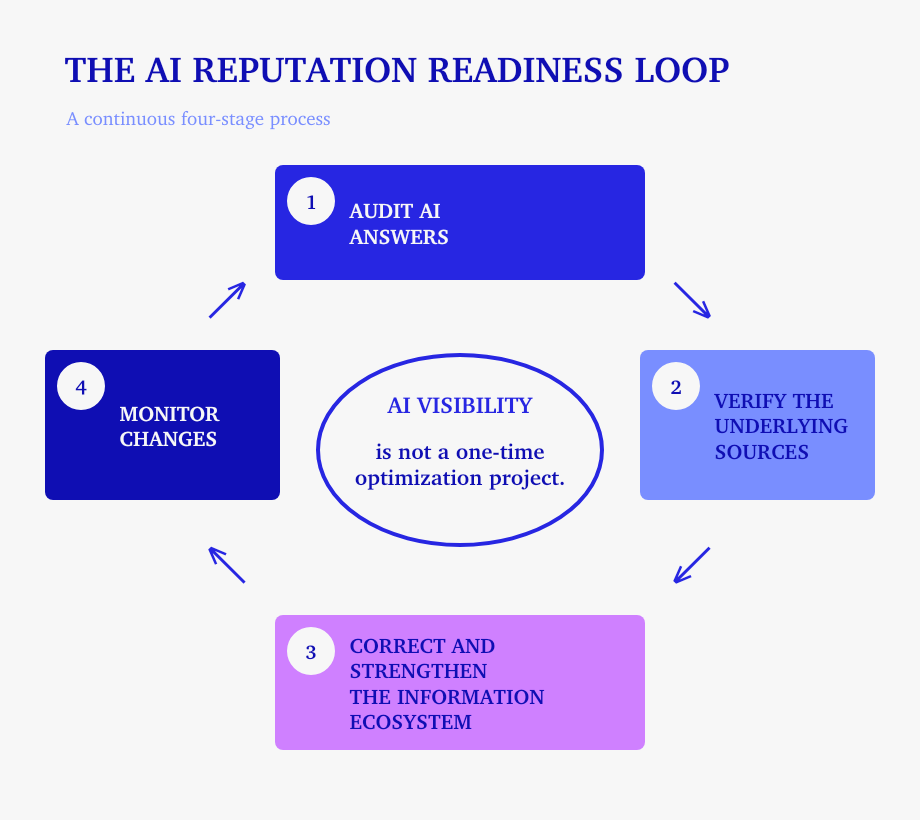
Companies should begin by testing the questions that real stakeholders are likely to ask. These should include branded, comparative, and risk-related prompts:
- What does this company do?
- Who owns and manages it?
- Is it regulated?
- Has it been involved in controversy?
- How does it compare with its competitors?
- What should an investor or customer know before working with it?
Review the answers across several AI systems and languages. A company may be described accurately in English but incorrectly in another language. One platform may identify current directors while another relies on an outdated biography.
Trace every important statement back to its source where possible. Correct errors in directories, biographies, records, or owned websites. Legitimate negative history should be accompanied by evidence showing its outcome or current status.
Finally, the company should monitor changes. AI-generated answers can evolve as models, retrieval systems, and online sources change. A positive audit today does not guarantee the same result after new media coverage, a leadership change, or a corporate restructuring.
The Company Website Is Only One Source
The European Commission’s decision does not resolve every concern about generative search. It does something more fundamental: it formally places ChatGPT among the information services whose scale and influence require enhanced accountability.
For businesses, that classification should end the debate over whether AI answers matter.
They matter because people use them to research companies. They matter because a synthesized response can shape a decision before the organization has an opportunity to speak. They matter because an inaccurate description, unresolved allegation, or missing source can influence customers, banks, investors, and partners.
Most importantly, they matter because the company may never see the decisions that follow.
“The strategic question is no longer whether AI will become part of corporate reputation. It already is. The question is whether the information available to these systems allows them to describe your company accurately, credibly, and in the right context.”
Corporate reputation is no longer shaped only by media coverage, Google results, or the company website. It is increasingly shaped by the answer generated between the search and the decision.
The EU has recognized ChatGPT as a search engine.
Now companies must determine whether they are ready to be searched through it.
For more on how AI is changing the risks businesses face, read When AI Can Fake Evidence: The New Reputation Crisis, which explores how fabricated images can undermine corporate trust and why verifying evidence matters.
Have a questions? Let's get in touch
→ Contact us: hi@reputation.city