
AI’s Most Valuable Role Is Turning Business Chaos Into Structure
The biggest obstacle to AI adoption may not be technology. It may be the fact that many businesses do not fully understand where their information is, who controls it, or how it should be used.
Companies are investing in increasingly advanced AI tools while employees continue to spend hours searching for documents, checking old conversations, reviewing meeting notes, and trying to reconstruct decisions that have already been made. The information exists, but it is scattered across inboxes, recordings, messaging platforms, internal systems, and individual employees.
In other words, businesses need structure.
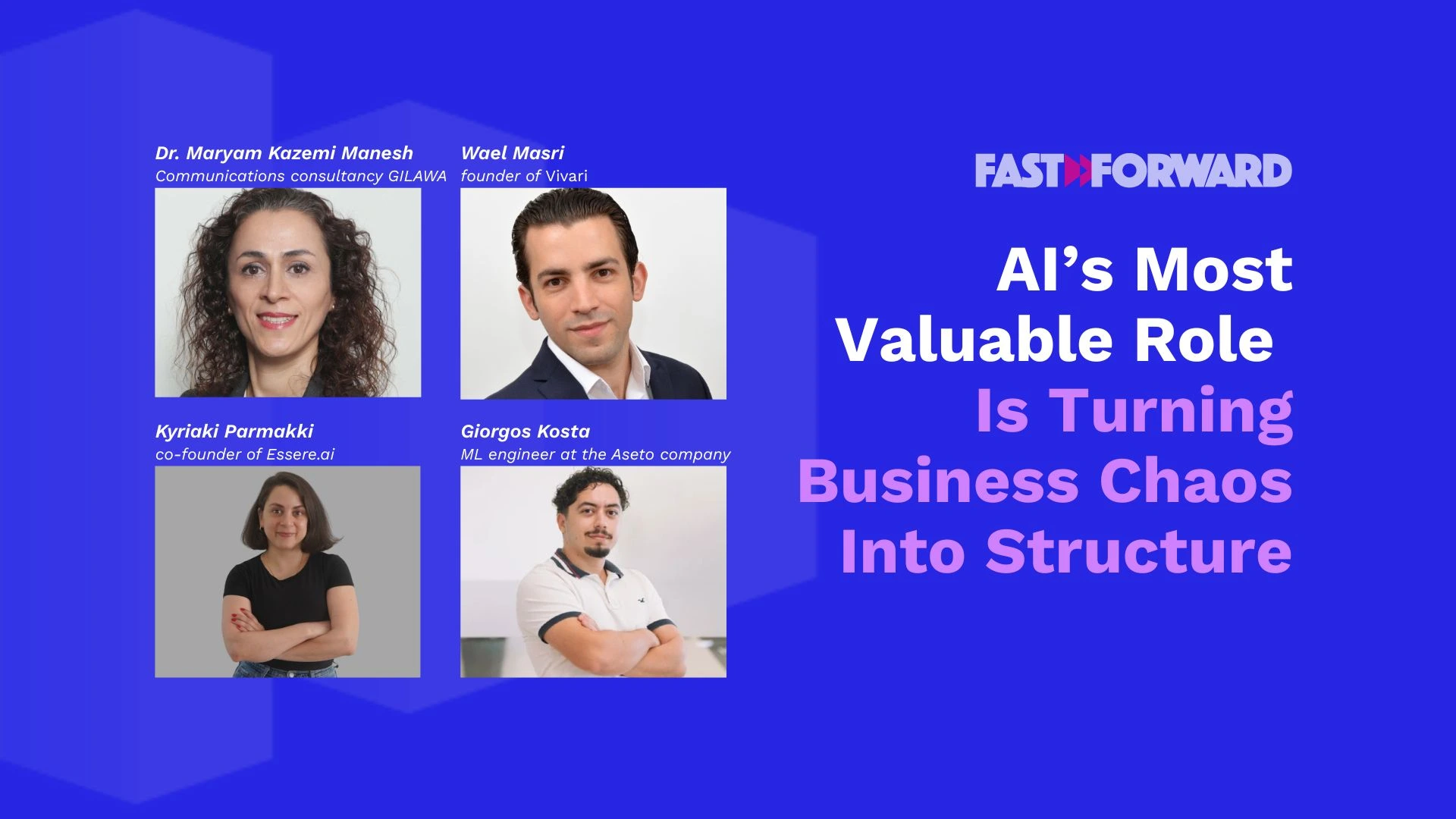
In her latest article for Fast Forward Magazine, Marianna Konina, Founder and CEO of Reputation City, examines how companies can use AI to organize their existing knowledge, improve decision-making, and build systems that are both faster and more reliable.
The article is based on insights presented at AI Expo Cyprus 2026, where experts in AI readiness, voice technology, communications, cybersecurity, and compliance approached the subject from different perspectives. Yet their conclusions pointed in the same direction: the real value of AI begins when it turns fragmented business knowledge into something people can actually find, understand, and use.
Businesses Are Losing Time to Information They Already Have
A company can generate thousands of emails, calls, documents, presentations, and internal discussions every month. However, having more data does not necessarily mean having more knowledge.
Research commissioned by Glean and conducted by The Harris Poll among 1,043 knowledge workers found that employees spent at least two hours each day searching for the documents, information, or people they needed. That represents approximately one quarter of the working week. Almost half of those surveyed said this frustration could even make them consider leaving their jobs.
The problem was not the absence of information, but the absence of a system connecting it.
AI can help businesses close this gap. Instead of simply generating new content, it can organize existing materials, extract knowledge from conversations, connect related decisions, and make internal information searchable.
But this opportunity comes with an important condition: AI cannot introduce order into a business that has never defined how its information should be managed.
AI Readiness Starts Before the Tool Is Purchased

Kyriaki Parmakki, Co-founder of Essere.ai, highlighted a common mistake in corporate AI adoption: businesses often select an AI agent before preparing the environment in which it will operate.
AI readiness is not simply a question of choosing the right platform. It requires clear data, structured processes, assigned responsibility, and an understanding of where information is stored.
Before introducing AI, a company must be able to answer several basic questions:
- What business problem are we trying to solve?
- What information will the system need?
- Who owns and verifies that information?
- What decisions can AI support or perform?
- Where must human approval remain mandatory?
If these questions have no clear answers, adding an AI assistant may only automate existing confusion. A chatbot connected to poorly organised or outdated information will not make a company smarter. It may simply produce unreliable answers more quickly.
Turning Forgotten Conversations Into Business Knowledge

A large part of a company’s most valuable knowledge is never written down. It is spoken during calls, meetings, consultations, and customer conversations—and then effectively disappears into an archive.
Giorgos Kosta, Machine Learning Engineer at Cyprus-based voice AI company Aseto, demonstrated how speech technology can unlock this information. Once audio is transcribed accurately, conversations can become a searchable source of business knowledge.
However, transcription quality is critical. A single incorrectly recognized word can distort every process that follows, from summaries and categorization to recommendations and automated decisions.
This challenge is especially relevant for languages and dialects that are not adequately supported by global AI providers. Aseto therefore developed its own speech model for Cypriot Greek, achieving a lower word error rate on real local phone calls than several major international and open-source alternatives.
The example reveals a broader principle: the most powerful AI solution is not always the largest or most internationally recognized one. It is the solution that understands the specific language, context, and operational needs of the business using it.
Start With the Problem, Not the Technology

Dr. Maryam Kazemi Manesh of GILAWA brought the discussion closer to implementation. Her approach begins by identifying a measurable business problem rather than selecting a technology first.
The process is practical: define the pain point, calculate its impact, assess whether AI can realistically solve it, and then determine whether the organization is prepared to support the system.
This prevents businesses from investing in impressive tools that employees cannot integrate into their everyday work.
Her example involved deploying AI voice agents through WhatsApp and other communication channels already familiar to users. The solution also used local hosting to address data privacy requirements. Instead of forcing the business to adapt to the technology, the technology was designed to fit the business.
That distinction matters. Successful AI adoption is not about introducing the most sophisticated model available. It is about creating a system that employees can use, customers can trust, and the organization can control.
Smarter AI Requires Stronger Control

As AI moves from providing information to taking action, governance becomes even more important.
Wael Masri, Founder of Vivari, focused on the systems that must surround AI before businesses can trust it with operational responsibilities. His perspective is particularly relevant because increasingly capable models do not necessarily create fewer risks. Their mistakes can simply become more convincing and harder to detect.
A reliable AI environment therefore needs:
- Access to carefully selected context rather than every available company file
- Memory that preserves information relevant to the task
- Permissions limited to specific actions
- Independent review supported by evidence
- Clear records of what the system has done
- The ability for a human to intervene without losing the work already completed
Masri also questioned the idea of recreating an entire corporate hierarchy through AI roles such as an “AI CEO,” “AI CMO,” or “AI CTO.” Software does not need to copy human job titles. In many cases, specialized systems with limited responsibilities and controlled access are safer and more effective.
The more capable AI becomes, the more important this management layer will be.
Why Information Structure Is Also a Reputation Issue
For Reputation City, this discussion goes beyond operational efficiency.
An organization’s reputation is increasingly shaped by how accurately information about it can be found, interpreted, and verified. Search engines, AI platforms, journalists, investors, partners, customers, and compliance teams all rely on available data when forming conclusions about a company.
If the organization’s own information is fragmented, inconsistent, outdated, or difficult to verify, external systems may reproduce the same confusion.
A company cannot fully control how others interpret its reputation. But it can improve the quality and structure of the information on which those interpretations are based.
This includes maintaining consistent corporate data, documenting important decisions, preserving reliable evidence, monitoring digital sources, and ensuring that official information can be found across both traditional search and AI-generated answers.
AI adoption and reputation management therefore share the same foundation: structured, accurate, and verifiable information.
Structure Comes Before Scale
The most immediate value of AI may not come from replacing employees or creating an autonomous digital workforce. It may come from helping people recover the knowledge their organizations have already created.
When calls become searchable, decisions become traceable, permissions become clear, and information is connected to its source, businesses can move faster without losing control.
But AI cannot compensate for weak foundations. Before asking what a model can do, companies should ask whether their data, processes, responsibilities, and safeguards are ready to support it.
The future of business AI will also depend on who can transform organizational chaos into knowledge that people and machines can trust.
Read the full original article by Marianna Konina in Fast Forward Magazine.
To explore how automation can give professionals more time for ideas, strategy, and human judgment, read our related article: “AI Does Not Replace Creativity. It Gives It Time to Work”.